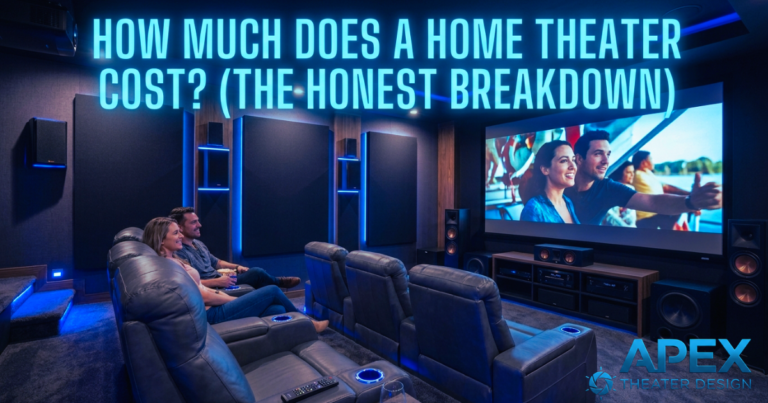
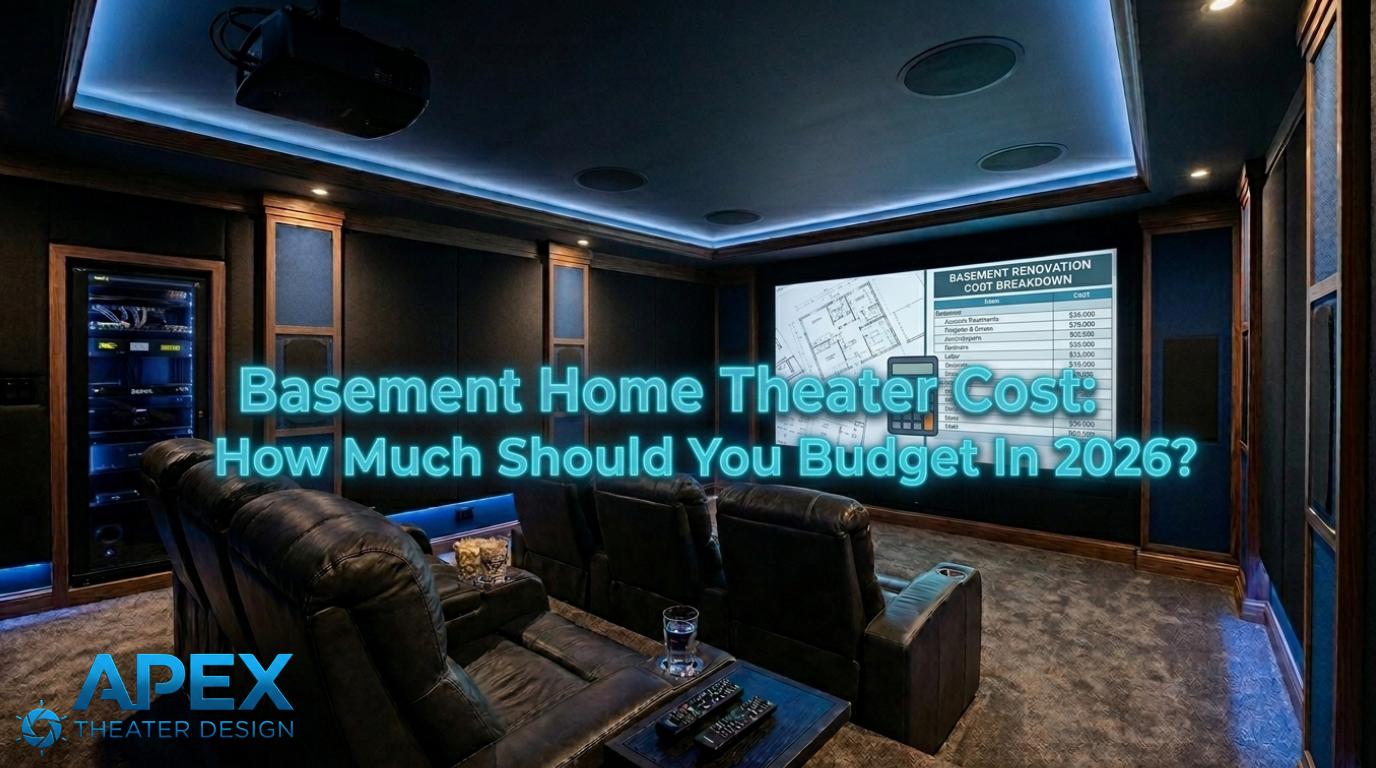
A basement is one of the best spaces in any home for a dedicated theater. The low ambient light, structural separation from the main living areas, and the natural thermal stability of below-grade spaces all work in your favor.
But basement home theater cost varies more than most planning guides acknowledge, and the variables that drive the number up or down have less to do with the gear you choose and more to do with the condition of the room you are starting with.
I have built two basement theaters from scratch and helped a handful of friends plan theirs. The finished costs ranged from just under $4,000 for a functional setup in a pre-finished space to over $30,000 for a fully treated, purpose-built room with tiered seating and an acoustic ceiling.
Both delivered excellent results. The difference was the scope, not the competence of the planning.
This guide breaks down basement home theater costs honestly, across room prep, equipment, and installation, so you can build a realistic budget before you buy a single piece of gear.
Why Is A Basement The Best Room For A Home Theater?
The case for setting up a theater in the basement goes beyond preference. Above-grade rooms deal with window placement challenges, foot traffic noise from adjacent spaces, and HVAC runs that are harder to route cleanly.
A basement eliminates most of those problems before you spend a dollar.
Natural light control is the most immediate advantage. Most basements have small or no windows, which means projector performance is substantially better without the blackout infrastructure that above-grade rooms require.
If your basement does have egress windows, budget for blackout shades or light-blocking panels, but even that is a simpler fix than managing a room with multiple large windows.
Sound containment is the other major advantage. Concrete and masonry walls are acoustically massive, meaning sound transfer to adjacent rooms is far less of an issue than in a wood-framed main floor room.
That said, the concrete walls themselves are reflective and will create echo problems if left untreated. Acoustic treatment is still necessary, but the isolation benefit is real.
How Much Does It Cost To Prepare A Basement For A Home Theater?
The single most common mistake I see in basement movie theater budgets is treating room prep as a minor line item.
In an unfinished basement, getting the space ready for a theater can consume anywhere from $3,000 to $15,000 of your budget before a single speaker is installed.
Framing and drywall for an unfinished basement room typically runs $2,000 to $6,000, depending on room size and whether you are hiring the work out.
Add a dropped ceiling for acoustic tile, speaker placement, and HVAC concealment, and that’s another $1,500 to $4,000.
Electrical work, including dedicated 20-amp circuits for AV components and adequate lighting circuits, is not optional and usually costs $800 to $2,500, depending on your panel distance and local labor rates.
Moisture is a basement-specific concern that can derail an entire project. Before any drywall or acoustic treatment goes up, the room needs to be confirmed dry. If you have any history of water intrusion, address it before investing in a theater.
Remediation costs vary widely, but skipping this step and building over a moisture problem is a mistake that tends to reveal itself expensively later.
A pre-finished basement cuts most of these costs. If the room has drywall, lighting, and electrical already in place, your room prep budget might be as low as $500 to $1,500, covering light control, minor acoustic adjustments, and any cable routing you need to open walls for.
RELATED: Home Theater Renovation Cost Guide
Basement Home Theater Equipment Costs by Budget Tier
Budget Basement Home Theater Cost: $3,000 to $6,000
At this level, you are working with:
- A capable 4K projector in the $700 to $1,200 range
- Fixed-frame projection screen
- AV receiver in the $300 to $500 range
- Speaker package covering a basic 5.1 configuration
This is an achievable setup in a pre-finished basement room where you are not doing heavy construction.
The performance ceiling here is quite good. A properly calibrated 5.1 system in a basement with even minimal acoustic treatment will outperform a premium soundbar setup at twice the price.
The trade-off is that projectors in this range have limited brightness, which works fine in a dark basement but struggles in any ambient light.
Lamp-based projectors at this price also require bulb replacements every few thousand hours, typically costing $100 to $200 per bulb.
Mid-Range Basement Home Theater Cost: $8,000 to $18,000
This is where basement home theater builds start feeling purpose-built rather than improvised. A mid-range setup includes:
- Laser projector or a high-performance 4K lamp unit with strong HDR capability
- A more capable AV receiver handling seven or more channels
- Quality discrete speaker system
- Proper acoustic treatment package
- Seating chosen for the space
The laser projector is the upgrade that makes the most practical difference at this tier. Laser light sources last significantly longer than lamp equivalents, typically 20,000 hours or more, and maintain more consistent brightness over time.
I ran a lamp projector for four years before noticing the brightness drift that comes with an aging bulb, and by the time I recalibrated it, the image quality had degraded in ways I had been unconsciously adjusting to. The laser units at this price point remove that variable entirely.
Acoustic treatment also becomes a real budget line here. Bass traps in the corners, broadband panels on the primary reflection points, and ceiling cloud panels above the seating position collectively address the most damaging acoustic problems in a rectangular basement room.
A functional treatment package for a 12-by-18-foot room costs roughly $800 to $2,500, depending on whether you build your own panels or buy finished ones.
High-End Basement Home Theater Cost: $20,000 to $50,000+
A high-end basement theater is a whole different project from an equipment standpoint and a construction standpoint. Think of equipment such as:
- Tiered flooring for raised rear seating
- Motorized seating
- Full acoustic wall coverage
- Reference-grade projector
- Full Dolby Atmos speaker configuration with in-ceiling height channels
- Rack-mounted AV system with professional cabling
- Control system (all these push the cost well past $20,000)
At this level, professional installation is not optional in any practical sense. The system complexity, the custom cabinetry, the acoustic design, and the integration of control systems require experienced integrators.
Labor costs for a full high-end build typically run $5,000 to $12,000 on top of equipment costs.
The performance difference between a well-executed mid-range build and a high-end build is meaningful but not transformative for most viewers.
The biggest gains at this level are in room acoustic precision, seating comfort over extended viewing, and operational convenience through automation.
If you are building for serious, dedicated use and long-term satisfaction, the investment holds up. If you are building to impress visitors, the mid-range tier achieves that at a fraction of the cost.
RELATED: Does A Home Theater Increase Home Value?
What Hidden Costs Should You Budget for In A Basement Home Theater?
Cable management and conduit installation are real costs that most planning tools ignore. Running HDMI, speaker wire, and power cleanly through a finished basement wall requires either hiring an electrician for the in-wall portions or investing in quality surface-mount raceway and careful routing. Budget $200 to $800 for this event on a modest build.
Ventilation is more important in basements than people expect. AV equipment generates heat, and a sealed basement room without adequate airflow will cause receiver shutdowns during extended use.
A dedicated HVAC duct, a mini-split, or, at a minimum, a properly sized ventilation fan is a legitimate cost item. Expect $300 to $1,500, depending on what your existing HVAC can handle.
Projector mounting hardware is often priced separately from the projector itself. A quality ceiling mount with extension for proper throw distance costs $80 to $250. For longer throws or vaulted ceiling situations, that number climbs. This is a minor line item, but one that catches first-time builders off guard.
Frequently Asked Questions About Basement Home Theater Costs
If you are in the planning stage, these are the questions I get most consistently from people trying to work out a realistic number for their specific situation.
What is the average cost of a basement home theater?
Most basement home theater builds cost between $5,000 and $20,000 when you account for room prep, equipment, and basic installation. A pre-finished basement with a modest equipment budget can come in under $5,000. A fully treated dedicated room with quality gear runs $15,000 to $25,000. True high-end builds with tiered seating and reference audio exceed $30,000.
Is it cheaper to build a home theater in a basement than in another room?
In most cases, yes. Basements offer natural light control and better sound isolation than above-grade rooms, which reduces the cost of acoustic and light-blocking infrastructure. The trade-off is potential room prep costs in unfinished spaces. A pre-finished basement is typically the most cost-efficient starting point for any home theater project.
Do I need to finish my basement before building a home theater?
A completely unfinished basement requires drywall, electrical work, and climate control before it is usable as a theater. However, you do not need to finish the entire basement, just the dedicated theater space. Framing and finishing a 12-by-16-foot room within a larger unfinished basement is a targeted project that costs considerably less than a full basement renovation.
How much does acoustic treatment add to a basement home theater cost?
A functional acoustic treatment package for a standard basement theater room typically adds $800 to $3,000 to your budget. DIY panel builds using rigid fiberglass or mineral wool insulation reduce that cost significantly. Skipping acoustic treatment entirely in a hard-walled basement room is a common mistake that limits how well even expensive equipment performs.
Can I build a good basement home theater for under $5,000?
Yes, in a pre-finished space. A well-chosen 4K projector, a 100-inch fixed-frame screen, a capable AV receiver, a 5.1 speaker package, and basic acoustic treatment can all fit within a $4,500 to $5,000 budget. The setup will not rival a purpose-built $20,000 room, but in a darkened basement with proper calibration, it delivers a genuinely cinematic experience.
Final Thoughts On Planning Your Basement Theater Budget
Basement home theater cost is ultimately a function of three things: the condition of your starting space, the equipment tier you choose, and how much of the work you handle yourself. None of those variables is fixed, and adjusting any one of them meaningfully changes the total.
The most important planning decision you can make before pricing equipment is an honest assessment of your basement. An unfinished concrete room requires a real construction budget before any AV component is purchased. A pre-finished, dry, light-controlled space lets you put the majority of your budget directly into performance.
Prioritize audio over video, room readiness over equipment tier, and calibration over additional gear. Those three principles will produce better results at any budget level than chasing specification numbers on a spec sheet.
A basement theater built on that foundation will still be delivering a great experience years from now, and that is the measure that matters.