There is a question I get from homeowners at the start of almost every project: Will this increase what my home is worth? It is a fair question.
A dedicated home theater is a significant investment, and most people want to know whether they will see any of that money come back if they sell.
The honest answer is that it depends — and the factors that determine that answer have very little to do with how much you spend on equipment.
After more than 15 years designing and installing home theater rooms across every budget level and property type, I have seen media rooms help homes sell faster and seen lavishly overbuilt cinema rooms make buyers walk away.
The difference almost never comes down to the projector brand or the speaker count. It comes down to how well the room was planned, how professionally it was executed, and whether it fits the home it lives in.
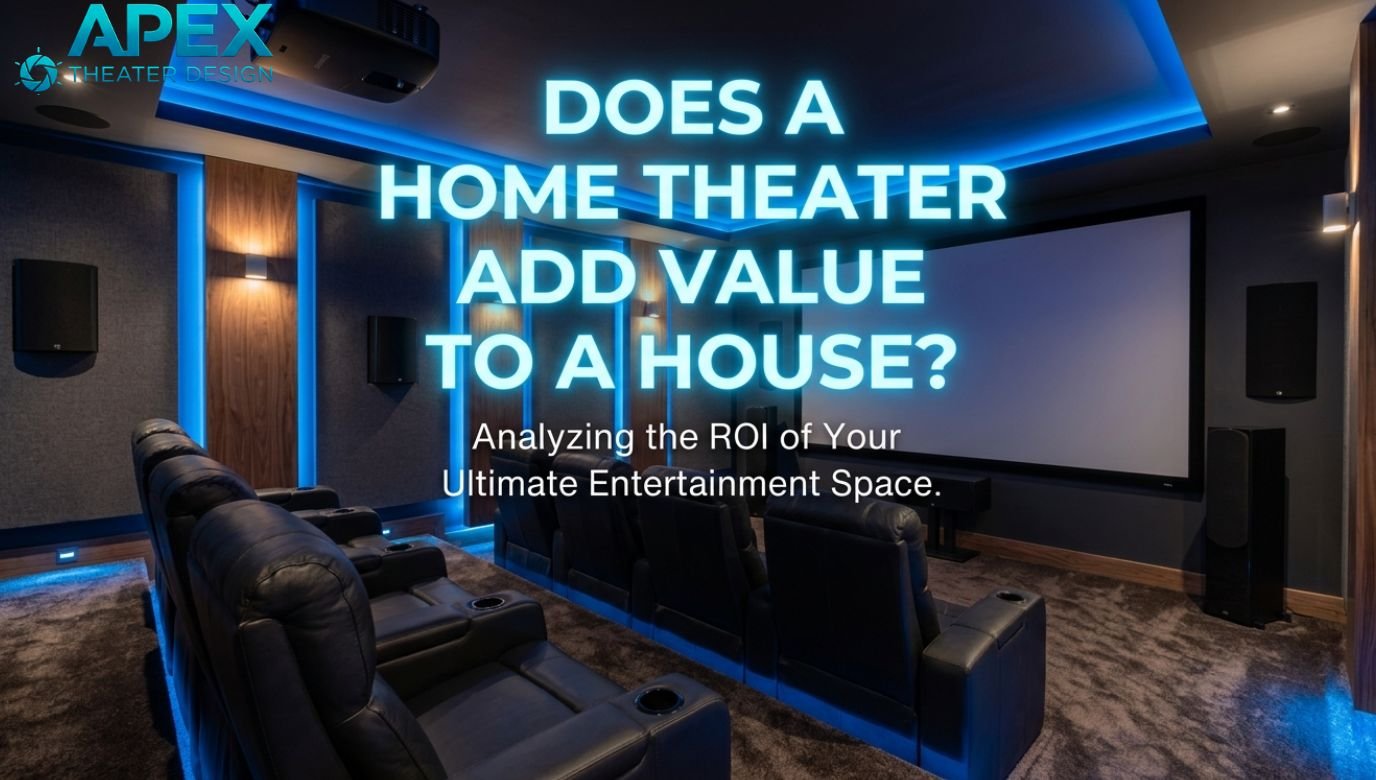
This guide gives you a clear, honest answer to “Does a home theater add value to a house?” and exactly what separates a theater that becomes a selling advantage from one that becomes a liability.
Quick Answer: Does A Home Theater Add Value?
A home theater adds value in certain contexts, has a neutral effect in others, and can work against a sale when it is poorly executed or too narrowly designed.
In higher-end homes and luxury real estate markets, a well-designed media room is increasingly expected by buyers and can meaningfully support a faster sale and stronger offer.
In average or entry-level homes, most buyers will appreciate the feature but will not pay a premium for it.
And in any home, a theater that looks unfinished, sounds poor, or operates through a confusing control system will raise more doubts than interest during a showing.
The short version is: buyers pay for quality design and ease of use, not for expensive equipment.
When A Home Theater Adds Value To A House
A home theater does not automatically raise a home’s value, but in the right market and design, it can become a genuine selling advantage.
In Higher-End Homes
In the luxury segment, a dedicated theater or media room has become a standard lifestyle feature, much like a chef’s kitchen or a spa-style bathroom.
Buyers shopping at this level expect extra amenities and will compare properties against that expectation. A well-executed theater room in a luxury listing signals that the home was cared for and upgraded thoughtfully.
I have worked on several installations in higher-end properties where the media room was specifically called out in the listing and became a primary reason a buyer scheduled a showing. That kind of draw is real in the right market.
When It Looks and Feels Professionally Built
Buyers respond to the quality they can see and hear immediately. A room with clean cable management, a well-balanced sound system, comfortable seating at the right viewing distance, and a simple control interface reads as a genuine upgrade. It feels like something they would enjoy.
The opposite is equally true: If a buyer walks into a room and the first thing they notice is a tangle of cables behind the TV stand or a projector screen that hangs crooked, the perception of quality drops immediately, regardless of what the equipment costs.
When It Functions As A Multipurpose Space
A media room that can also serve as a family lounge, a comfortable sitting room, or even a flex space appeals to a wider range of buyers than a room designed exclusively as a dark, fixed-seat cinema.
The more narrowly a space is built around a single use, the smaller the pool of buyers who will see themselves living in it.
The installations that hold their value best are the ones that prioritize the experience without eliminating other possibilities for the space.
When It Clearly Improves Daily Life
Buyers make emotional decisions and justify them logically afterward. A home theater that evokes an obvious lifestyle benefit, e.g., family movie nights, weekend sports viewing, a genuinely immersive gaming setup, etc., creates an emotional connection that supports the asking price without necessarily appearing in an appraisal figure.
When A Home Theater Does Not Add Value
In many homes, a theater setup does not translate into higher resale value and can even weaken buyer interest when it is too specialized, poorly executed, or misaligned with the property’s market level.
Here are instances where a home theater fails to add value in most properties:
In Small or Mid-Range Homes
A home theater in a property at the lower end of its market will generally not move the needle on sale price. Buyers in that segment have a different set of priorities, and a theater room does not address them. The money spent on the installation will likely not return at closing.
That does not mean you should not build one. It means you should build it for your own enjoyment and budget accordingly, without expecting the investment to come back.
When It Is Too Customized
I have walked into rooms built around extremely specific themes such as full sports team branding, horror film aesthetics, and elaborate custom murals. These made it impossible for most buyers to picture themselves using the space. Personal style in a home theater is fine. A theme that is so specific that it alienates buyers is a problem.
The same applies to fixed tiered seating with no flexibility. A buyer with three young children and a buyer who hosts adult dinner parties both need to picture themselves in this room. If the layout only works for one scenario, you have already lost a portion of your potential market.
When It Is Poorly Installed
It’s pretty easy to spot a poorly designed home cinema room. Talk of visible wires, dialogue that sounds unclear from the listening position, and a control system that requires a manual to operate.
All these details do not just fail to impress buyers, they actively undermine confidence in the rest of the home. Buyers start wondering what else might have been done poorly if they notice obvious problems in a room that was supposed to be a feature.
When It Eliminates A Needed Space
Converting a bedroom, especially in a home where the bedroom count is already at the minimum buyers in that market expect, into a dedicated theater will cost you more in buyer appeal than the theater feature will ever return.
Before committing to a dedicated cinema room, confirm that the conversion does not reduce the functional bedroom count below what comparable homes in the area offer.
What Home Buyers Actually Want In A Home Theater
Having been on job sites with real estate agents showing properties that include theaters I installed, I have learned what buyers respond to versus what I thought they would care about.
- Simple controls matter more than anything else: A buyer who picks up a remote during a showing and cannot figure out how to make the screen come on immediately categorizes the room as a complication, not a benefit. One-button or one-app operation is not a luxury at this point; it’s the baseline expectation.
- Sound quality is noticed even without conscious evaluation: When a room is balanced correctly, and dialogue is clear from the seating position, buyers register it as a pleasant, comfortable space. When the acoustics are poor, and voices sound hollow, or the bass is boomy, buyers feel vaguely uncomfortable without always knowing why. Acoustics shape perception more than any visual element.
- The seating arrangement tells people immediately whether the room works: Seats that are spaced correctly, positioned at a comfortable viewing distance, and arranged so that every seat has a good sightline communicate that the room was designed by someone who knew what they were doing.
- A clean visual presentation closes the deal: No exposed wires. No equipment is sitting on the floor. No screens or projectors that look dusty or misaligned. The visual first impression during a showing sets the ceiling on buyer interest.
Types of Home Theater Setups and Their Value Impact
In this section, we break down the main types of home theater setups and how each one typically affects perceived value, performance, and resale impact.
Basic TV Setup with Soundbar
A large-format TV with a quality soundbar and a pair of seating pieces creates a pleasant media space at minimal cost. At the $500–$2,000 range, this type of setup makes a room feel comfortable and functional but does not register as a dedicated home theater feature to most buyers. Resale impact: minimal.
Mid-Range Surround Sound System
A properly installed 5.1 or 7.1 surround sound system with an AV receiver, in-wall or on-wall speakers, a quality display, and basic acoustic treatment in the $2,000–$10,000 range hits the sweet spot between genuine performance and broad buyer appeal. This is the tier most likely to accelerate a sale in a family home or mid-range property. Resale impact: moderate positive.
High-End Dedicated Cinema Room
A fully dedicated cinema room with Dolby Atmos, premium laser projection, soundproofing, custom seating, and professional calibration at $10,000 and beyond delivers an experience that’s genuinely impressive to any buyer, but the financial return is largely limited to luxury markets.
In a standard residential neighborhood, this level of investment rarely returns its full cost. Resale impact: strong lifestyle differentiator in luxury; limited in standard markets.
ROI: What To Realistically Expect
Appraisers generally credit home theater spaces at roughly 50 to 75 cents per dollar spent during the formal valuation process. This figure reflects the reality that a home theater is a lifestyle feature, not a structural one.
However, appraisals rarely capture buyer psychology. A well-executed media room can shorten time on market, support a listing price at the higher end of the comparable range, and attract buyers who might otherwise overlook the property. That influence is real but difficult to quantify precisely.
The most honest guidance I can offer from years of post-installation conversations with both clients and their real estate agents:
A home theater built for enjoyment, executed professionally, and designed for flexibility will rarely hurt a sale and will often help one. A home theater built as an investment calculation will rarely deliver the return you are hoping for.
Cost vs. Value: Where To Spend Wisely
The most common financial mistake I see homeowners make is spending heavily on equipment while underinvesting in installation quality and acoustic treatment.
A $5,000 speaker system in a room with visible cables, poor speaker placement, and no acoustic treatment will impress buyers far less than a $2,000 speaker system installed cleanly, placed correctly, and supported by even basic room treatment.
For buyers evaluating a property, the quality of execution reads as the quality of the product. They cannot evaluate component specifications during a 20-minute showing. They can absolutely evaluate whether the room looks and sounds like it was done by someone who knew what they were doing.
Spend adequately on the installation. Hide every cable. Get the speaker placement right before the room is finished, so you are not trying to patch positions after the fact. Budget for at least basic acoustic treatment — even wall-to-wall carpet and a few strategically placed panels make a measurable difference in how a room sounds to a first-time visitor.
RELATED: Basement Home Theater Cost: How Much Should You Budget In 2026?
Design Principles That Protect Your Investment
Good design choices separate a home theater that adds value to your home from one that quietly works against it when it is time to sell.
- Keep Controls Simple: Before any installation is complete, I run every client through the control interface with one instruction: find the movie mode and press play. If they hesitate for more than a few seconds, the system is too complex. That same test applies during a buyer showing. Simplicity signals quality.
- Prioritize Sound Quality Over Screen Size: The most memorable rooms I have built are not always the ones with the largest screens. They are the rooms where buyers sat down, heard dialogue come clearly from the center channel, felt the bass in their chest at the right moment, and said something like “this actually sounds incredible.” Sound quality creates emotional impact. Screen size creates initial visual interest. Sound keeps people in the room.
- Use Neutral Design Language: Avoid heavily themed decor. Keep wall colors dark but neutral. Deep charcoal, navy, or dark gray work well and do not signal any particular aesthetic allegiance. Choose seating that looks comfortable and clean rather than highly customized. The goal is for buyers to see themselves using the space, not to marvel at someone else’s personality.
- Hide Every Cable: There is no single detail that communicates quality more efficiently than zero visible wires. In-wall wiring, proper cable management through equipment racks, and furniture placement that keeps connections out of sightlines all contribute to a first impression that is immediately positive.
Common Mistakes That Reduce Value Instead of Adding It
Even well-funded home theaters can hurt resale value when these common design and execution mistakes are made:
- Overbuilding for the home type: A $40,000 cinema room in a $300,000 home doesn’t always translate to a sound investment. The room’s sophistication exceeds what that market’s buyers expect or will pay for.
- Poor acoustic planning: A room that echoes, a bass response that is boomy in half the seats, or dialogue that disappears into the room noise — all of these communicate amateur execution, even if the equipment was expensive.
- Overly complex control systems: Every additional remote, every app that must be open before something works, every input that must be manually switched — these all reduce buyer confidence. Consolidate control wherever possible.
- Converting a bedroom in a home where bedroom count matters: In most residential markets, bedroom count is a primary search filter for buyers. Reducing it below the market norm to gain a theater room is trading a fundamental feature for an amenity.
Professional Installer Insights
Room shape matters more than most homeowners realize. Square rooms produce standing bass waves that make certain frequencies stack up and become overwhelming at specific seat positions. Rooms that are roughly 1.6 times as long as they are wide tend to behave more predictably from an acoustic standpoint and are easier to treat effectively.
Calibration improves any system at any price point. The built-in auto-calibration tools in modern AV receivers — Audyssey, YPAO, MCACC — do a reasonable job for everyday listening but leave meaningful performance on the table. A manual calibration using a measurement microphone and room correction software takes an hour and can transform how a well-positioned system sounds in ways that are audible to anyone in the room, regardless of their experience level.
Heat management for equipment is a detail that shows up in long-term reliability rather than immediate performance. An equipment rack or cabinet without proper ventilation will shorten the lifespan of receivers and amplifiers through repeated thermal stress. This matters more for resale than it might seem. A buyer testing the system during escrow who discovers a failed component will legitimately question the quality of the installation.
How To Make A Home Theater Help Sell Your House
Below, I share some tips on how to present and design your home theater so it enhances buyer appeal and actively supports a stronger sale:
- Stage the room the same way you would stage any feature space in a property, ensuring it feels polished, intentional, and ready for showings
- Clean and organize every visible surface so the space appears well-maintained and free of distractions
- Confirm that every piece of equipment powers on correctly, so there are no surprises during buyer visits
- Set the lighting to a warm, inviting scene rather than full blackout mode to make the room feel more welcoming and livable.
- Arrange seating so sightlines to the screen are immediately obvious, helping buyers quickly understand the room’s function.
- Brief your real estate agent on how the system works at a basic level so they can demonstrate it confidently during showings.
- Ensure the system is shown in action, since even a short demonstration can turn passive interest into real excitement, while a dark, unused setup feels forgettable.
- Market the space as a media room or entertainment room rather than strictly a home theater.
- Use inclusive, lifestyle-focused language that helps more buyers picture themselves using the space.
- Avoid overly niche “home theater” labeling, which can feel restrictive or overly specialized to non-enthusiast buyers.
Expert Checklist: Home Theater That Adds Value
- All cables completely hidden with no visible wiring
- Speaker system installed at the correct positions for the room dimensions
- Control system reduced to single-button or single-app operation
- Seating positioned at the correct viewing distance for the screen size
- Lighting on a dimmable, scene-based control system
- The room can reasonably serve another purpose if needed
- No overly personalized decor or fixed-theme design elements
- The equipment rack is properly ventilated with active cooling if enclosed
- The system has been calibrated with a measurement tool, not just factory settings
- Every component powers on and functions correctly before any showing
Does A Home Theater Add Value To A House FAQs:
These frequently asked questions break down the practical realities behind home theater investment and resale impact:
Does a home theater increase resale value?
A well-designed home theater can support a faster sale and a stronger listing position, particularly in luxury or upper-mid-range markets. In most standard residential markets, it rarely returns its full installation cost in the sale price. Appraisers typically credit home theater improvements at 50–75 cents per dollar spent. The primary return is experiential rather than financial, and planning should reflect that reality.
Is a dedicated home theater better than a media room for resale?
For most homeowners, a flexible media room that can serve multiple purposes is a safer investment from a resale standpoint than a dedicated cinema room with fixed seating and full blackout treatment. The dedicated room delivers a better cinema experience, but the media room appeals to a broader range of buyers. If the property is in a luxury market where buyers expect dedicated entertainment spaces, the calculus changes.
What type of home theater adds the most value?
A mid-range professionally installed system — clean wiring, in-wall surround speakers, a quality display, simple control, and comfortable seating at the correct viewing distance — in a room that retains some flexibility. This configuration delivers genuine performance that buyers can perceive during a showing while avoiding the narrow appeal of a fully dedicated cinema build.
Do buyers prefer projectors or large TVs?
In most residential contexts, large-format TVs are more immediately accessible to buyers during a showing because they work in ambient light and require no setup or explanation. A properly installed projector system in a controlled light environment can be equally or more impressive, but it requires the room to be set up correctly for demonstration and a buyer who is willing to engage with it. For pure ease of showing, a quality large-format TV in the 85–98 inch range is often the safer choice in non-luxury properties.
How much should I spend on a home theater for good ROI?
The mid-range is where value and return align most reliably: $2,000–$10,000 for a properly installed surround sound system, quality display, simple control, and basic acoustic treatment in an existing finished room. Above that level, you are building primarily for your own enjoyment, which is entirely legitimate, but with diminishing expectation of financial return at resale.
Can a poorly designed home theater reduce home value?
Yes, clearly. A room with visible wiring, poor sound quality, an unusable control system, or overly specific theming will register as a problem during a showing rather than an amenity. Buyers see a space that will require investment to correct before it is usable, and that perception reduces the offer, not the asking price the seller hoped for.
Is professional installation worth it for resale value?
Strongly yes. The quality of execution is the primary variable that determines whether a home theater helps or hurts a sale. Professional installation means hidden wiring, correctly positioned speakers, properly calibrated audio and video, and a control system that actually functions simply. These are precisely the details buyers notice during a showing, and they are the details amateur installations most frequently get wrong.
RELATED: Home Theater Renovation Cost: 2026 Pricing Guide
Key Takeaways
Ultimately, the answer to Does a Home Theater Add Value to a House depends on how well it is designed, executed, and matched to the property’s market.
A well-planned setup can enhance buyer appeal, support faster sales, and strengthen perceived value, especially in higher-end homes.
However, over-customized, poorly installed, or overly expensive systems rarely deliver a full financial return and can even reduce interest. The real value lies in professional execution, simplicity, and flexibility rather than equipment cost alone.