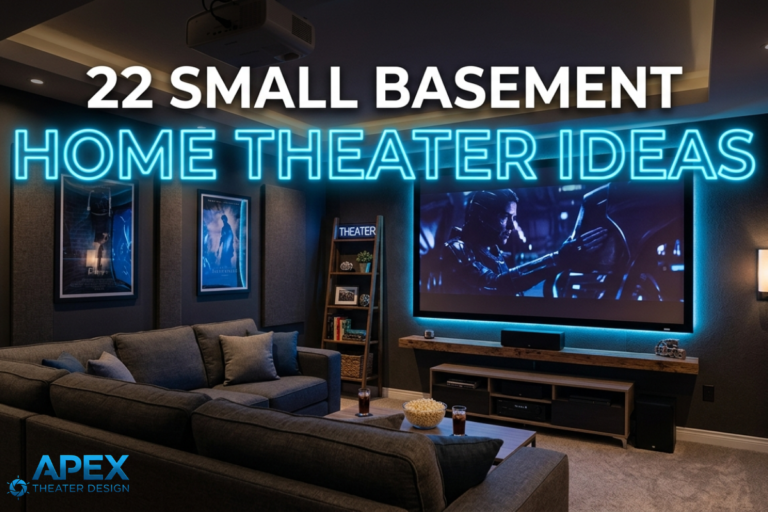
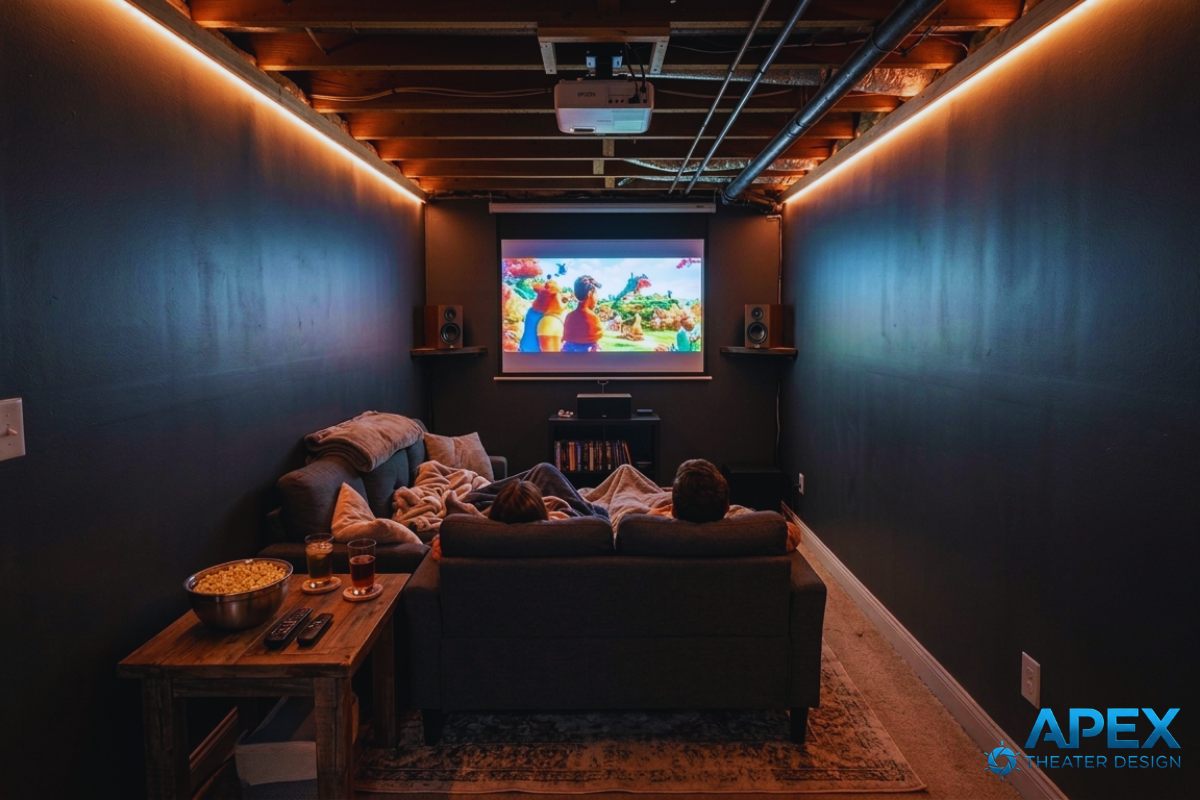
Can a small basement work as a theater? If you are looking at a small basement and wondering whether it can realistically become a home theater, the short answer is yes. In fact, some of the best private theaters I have helped build were in small basement rooms.
A basement naturally solves several problems that larger living rooms struggle with. It is usually darker, separated from the rest of the house, and surrounded by a thick structure that helps contain sound.
The challenge is that basements are often tight, oddly shaped, and full of obstacles like ductwork, support beams, or low ceilings.
Over the past 15 years, I have built theaters in rooms barely wider than the screen, in basements where the ceiling forced creative speaker placement, and in spaces where we had to move a subwoofer six different times before the bass stopped disappearing in the middle seat.
With good planning and realistic expectations, a small basement can deliver an excellent movie experience.
This guide walks through what matters when turning a small basement into a theater. Not the flashy upgrades that look impressive in photos, but the decisions that noticeably improve sound, picture quality, and long-term usability.
Table of Contents
Why Small Basements Often Work Surprisingly Well
Many beginners assume they need a large room to create a convincing home theater. But the truth is, smaller enclosed spaces often perform better for both audio and video.
The first advantage is light control. Basements usually have minimal windows, which makes it far easier to control ambient light. Even a modest projector or television can look dramatically better when the room is truly dark.
The second advantage is sound containment. Concrete foundation walls and earth surrounding the room help keep sound from spreading through the house. You still hear bass upstairs, but far less than you would in a living room setup.
The third advantage is viewing distance. In large rooms, people often sit too far from the screen, which reduces immersion. In a smaller basement, the seating position naturally lands within the ideal viewing range for both televisions and projectors.
The tradeoff is space management. In tight rooms, every foot becomes crucial. And that means you must carefully plan the speaker placement, seating layout, and equipment positioning.
The Most Important Question Is: How Small Is “Small”?
Before choosing equipment, the real starting point is measuring the room accurately.
In my experience, small basement theaters usually fall into three rough categories:
- Rooms around 10 x 12 feet can still work, but require careful compromises. Seating will likely be one row, and speaker placement may be tight.
- Rooms around 12 x 15 feet are the sweet spot. You can comfortably fit a single seating row with proper surround speakers and possibly a projector setup.
- Rooms around 12 x 18 feet or larger open the door for more flexibility, including larger screens or multiple seating rows.
Ceiling height also matters more than people expect. Many basements sit around seven feet tall, sometimes lower under ductwork. That does not kill the project, but it affects screen placement and speaker angles.
One lesson I learned the hard way: Always measure after drywall, flooring, and any ceiling finishing. I once designed a layout assuming eight feet of height. After finishing the ceiling with sound panels and lighting, we lost nearly six inches and suddenly the projector throw angle had to be recalculated.
You might be interested in our latest guide on 22 brilliant small basement home theater ideas.
Layout Planning (This Step Saves You Headaches Later)
Most mistakes in small basement theaters happen before any equipment is installed.
People buy gear first, then try to make it fit. Such an approach usually leads to awkward speaker placement and seating that feels cramped.
Instead, you should always start with the layout. And this includes:
Screen Wall Placement
In smaller rooms, the screen almost always goes on the shorter wall. This allows for the longest viewing distance possible.
A common mistake is trying to center the screen on the wall even when a support column or doorway interferes.
In small rooms, you sometimes have to shift things slightly to make seating and speakers work properly.
Symmetry matters more for sound than for aesthetics.
Seating Distance
For total immersion, the main seating position usually lands between 1.2 and 1.6 times the screen width. If the room is tight, lean toward the closer side.
Sitting slightly closer feels cinematic. Sitting too far makes even large screens feel underwhelming.
Equipment Location
Plan where key home theater equipment, like the receiver, media devices, and amplifiers, will live. Equipment racks generate heat and require cable paths.
Running cables after the walls are finished is one of the most frustrating jobs in home theater.
Check out this guide on the basement movie room floor plans
Choosing The Right Display For A Small Basement
One of the biggest decisions you’ll have to make is whether to use a large television or a projector. Both can work extremely well in a small basement.
Large Television Setup
For many beginners, a large television is the simplest and most reliable option.
Modern TVs in the 75-to-85-inch range provide excellent brightness and contrast with minimal setup. There is no projector alignment, no bulb replacement, and no concern about ambient light.
In small rooms where seating distance is under ten feet, a large television can feel quite immersive.
Projector Setup
Projectors create the classic theater experience. A 100-to-120-inch screen can completely fill your field of vision in a small room. However, projectors require more planning…
You must verify the throw distance, meaning the distance between the projector and the screen.
Many basements do not provide enough length for standard projectors unless you choose a short-throw model.
Projector brightness also matters. Basements are darker than living rooms, but you still want enough brightness to avoid a dull image.
I have also learned to plan access for future adjustments. Projectors slowly drift out of alignment over time. So, being able to reach the mount easily makes recalibration far less annoying.
Sound System Design for Tight Rooms
Audio is where small basements can shine if the system is configured correctly.
Even modest speaker systems can sound powerful in a compact room because sound reflections reinforce the listening position.
This is how to achieve excellent audio in your small basement home theater:
Start With A Proper Speaker Layout
The most practical starting point for beginners is a 5.1 surround system.
That includes:
- Front left and right speakers
- A center channel speaker
- Two surround speakers
- One subwoofer
Trying to cram a complex system like 7.1.4 into a very small room often causes more problems than improvements.
Center Channel Placement Matters
The center channel handles most dialogue, so its position is critical.
Ideally, it should sit directly below or behind the screen and be angled toward ear level.
If the speaker is too low, the voices sound disconnected from the screen. I have seen this happen when people place the center channel inside a cabinet several inches below the display.
Simply tilting the speaker upward can dramatically improve clarity.
Surround Speaker Position
In small rooms, the surround speakers usually sit slightly behind the seating position.
Mounting them too far forward collapses the surround effect.
When wall space is limited, slightly higher placement can help spread sound more evenly.
The Subwoofer Challenge In Small Rooms
I’ll be honest with you… When you ask the question “Can A Small Basement Work As A Theater,” you should understand that the bass is the most unpredictable part of a small basement theater.
Room dimensions create peaks and dips in bass response. These are called room modes, and they can make bass boom in one seat while disappearing in another.
I have lost count of how many times I thought a subwoofer was underperforming, only to move it three feet and suddenly hear the bass come alive.
So, what’s the best fix? I have a few suggestions for you:
The Subwoofer Crawl
A simple technique called the subwoofer crawl helps find the best location.
Place the subwoofer temporarily at the main seating position and play bass-heavy audio. Then crawl around the room and listen for where the bass sounds most balanced.
That location often becomes the ideal placement for the subwoofer. It sounds strange, but it works surprisingly well.
One Subwoofer vs Two
In small rooms, a single quality subwoofer can perform very well. Two subwoofers improve consistency across multiple seats, but they are not mandatory for a beginner setup.
If the budget allows future upgrades, plan space for a second subwoofer later.
Acoustic Treatment For Your Compact Home Theater
Acoustic treatment is one of the most overlooked improvements in home theaters.
Small basement rooms tend to produce strong reflections and bass buildup. Without treatment, dialogue can sound muddy, and surround effects blur together.
The first treatments I recommend are absorption panels at first reflection points. These are the wall locations where sound from the front speakers first reflects toward the seating position.
Installing a few well-placed panels can tighten the entire soundstage.
Bass traps in corners also help smooth out low-frequency issues. Even a couple of corner treatments can reduce boominess.
This is one area where modest DIY solutions can perform just as well as expensive commercial panels.
Lighting and Comfort In A Small Basement Theater
Lighting design is also a crucial part of your basement home theater design.
Bright overhead lights kill immersion. But complete darkness can make the room uncomfortable for guests.
The best balance usually includes dimmable lighting around the room perimeter and subtle step lighting near seating areas.
In one basement project, we added soft LED strip lighting behind the screen wall. It created a gentle glow that looked great and helped people move around safely when the movie ended.
Seating comfort also becomes more important in small rooms. If people sit closer to the screen, the viewing angle becomes steeper. Recliners or slightly tilted seating positions reduce neck strain during long movies.
Ventilation and Heat Management
Basements often trap heat from electronics. Projectors, amplifiers, and receivers generate more warmth than people expect. In small enclosed rooms, the heat builds quickly.
Plan airflow early. This might mean leaving space around equipment racks or ensuring the HVAC system can circulate air through the room.
One mistake I made years ago involved placing an AV receiver inside a tight cabinet without ventilation. During a long movie night, the receiver overheated and shut down halfway through the film. Since then, I have always prioritized airflow.
Common Mistakes In Small Basement Theaters
One of the mistakes beginners keep repeating when designing a small basement home theater is using oversized seating. Large recliners look great in showrooms but quickly overwhelm small rooms.
Another common mistake is placing the screen too high. When ceilings are low, people sometimes mount the display higher to avoid furniture. This forces viewers to tilt their heads upward for hours.
Poor cable planning is another headache. Always run extra cables and conduit if possible. Future upgrades are much easier when the infrastructure is already in place.
Budget Priorities That Can Improve Your Theater Performance
If your budget is limited, focus on the upgrades below to help you achieve the biggest improvements:
- A solid center channel speaker dramatically improves dialogue clarity.
- A quality subwoofer adds impact that smaller speakers cannot produce alone.
- Basic acoustic treatment often improves sound more than upgrading speakers.
- Expensive cosmetic upgrades rarely affect performance.
I have seen modest systems sound fantastic simply because the room layout and acoustics were handled correctly.
So, Can A Small Basement Work As A Theater?
Yes, and in many cases, it can work exceptionally well. A small basement theater requires careful planning, but it also creates an environment where sound and visuals can be controlled more easily than in open living spaces.
The key is prioritizing the basics. Start with room measurements and layout. Choose a display that fits the viewing distance. Focus on speaker placement and subwoofer positioning before chasing expensive upgrades.
Some trial and error is inevitable. I still find myself adjusting subwoofer placement or recalibrating speakers after living with a setup for a few weeks.
That process is part of building a theater that truly works for the room.
With good planning and realistic expectations, a small basement can deliver a cinematic experience that rivals much larger spaces.Top of Form